How Blockchain Reshapes Corporate Liquidity: From Failed Operations Risk to Supply Chain Finance Upgrades
Keywords: Blockchain, liquidity, supply chain finance, corporate credit, smart contracts, cash turnover
Introduction
In corporate operations, what truly determines a company’s vitality is not just sales volume, but whether cash flow can keep returning steadily and reliably. Many businesses appear to be growing rapidly on the surface, yet in practice they often face long capital occupancy periods, slow payment collection, and high credit risk. Once funds cannot turn over in time, the company falls into a liquidity shortage, which in turn affects procurement, production, expansion, and even survival.
1. Why Failed Operations Risk Erodes Corporate Liquidity
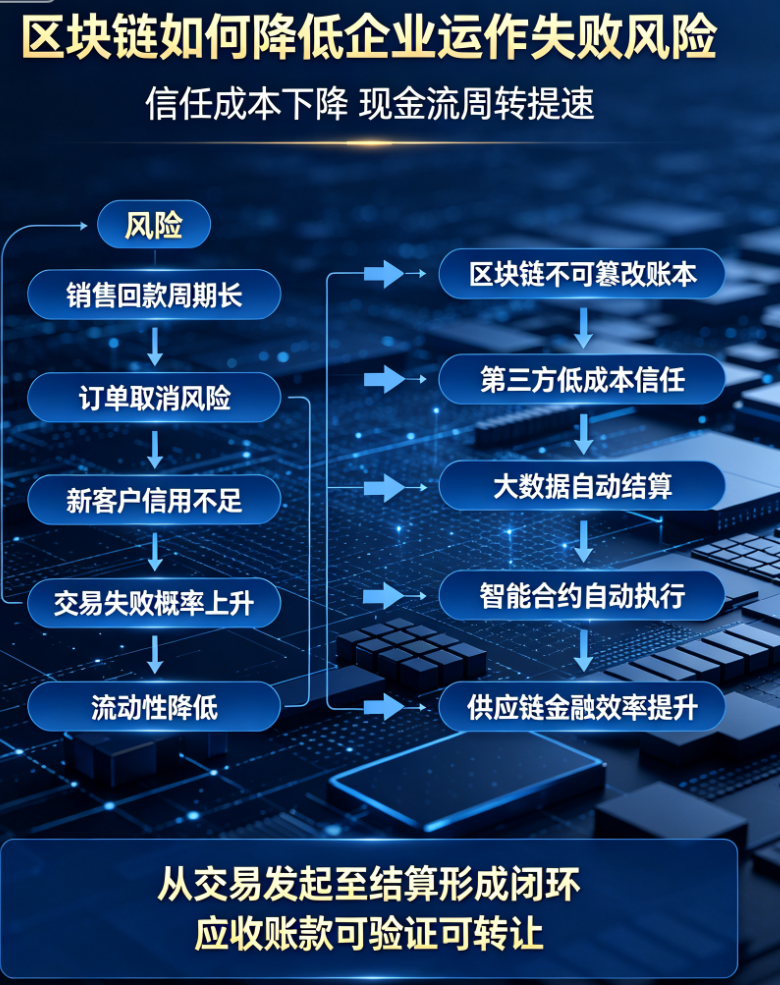
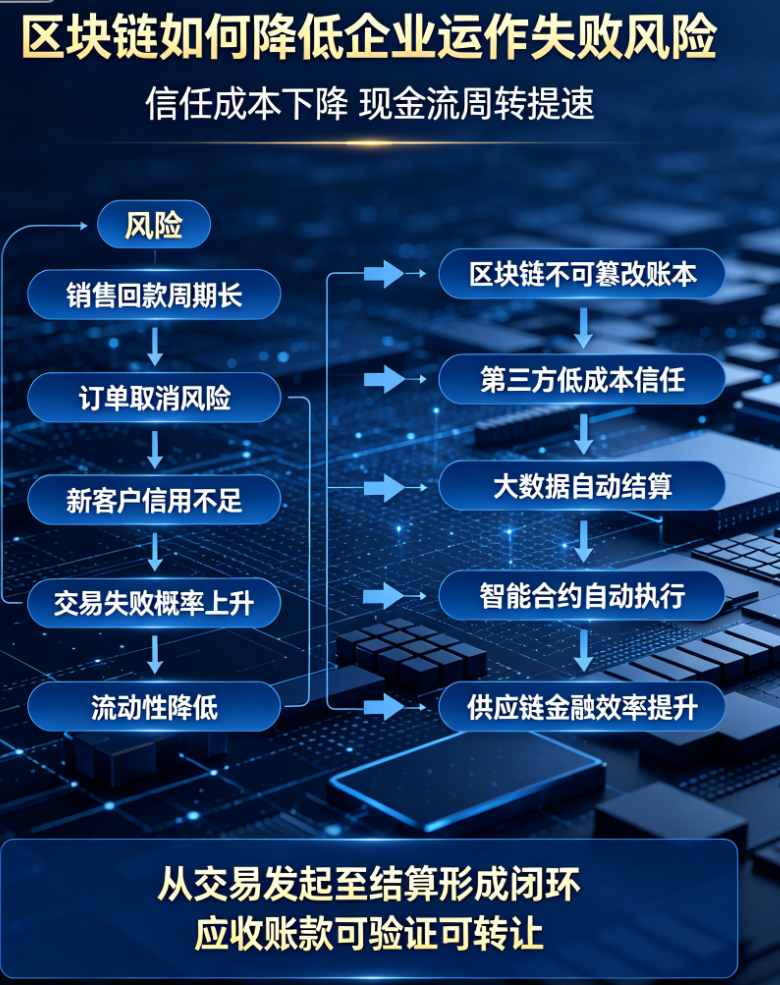
Failed operations risk refers to the potential losses caused by information asymmetry, insufficient credit, or low settlement efficiency during transactions and operations. First, a long sales collection cycle directly ties up company funds. If an order is paid late or even canceled, the production, logistics, and labor costs invested upfront may not be recovered. Second, when dealing with new customers, companies often need to spend more time verifying qualifications due to a lack of sufficient credit history, which not only raises transaction costs but also reduces closing efficiency.
More importantly, failed operations risk creates a chain reaction in the relationship between a company and its suppliers. To guard against bad debt, companies usually need stricter approvals, higher guarantees, and longer review cycles, which lowers cooperation efficiency and limits market share. In the long run, slower cash turnover, rising capital costs, and a forced increase in operating leverage will place a company at a disadvantage in competition. In extreme cases, if cash flow breaks down, the company may even go bankrupt.
2. Why Blockchain Can Become a Low-Cost Trust Mechanism
To solve these problems, the key is to establish a reliable, transparent, and low-cost trust system. This is where blockchain creates value. It does not rely on a single central institution to maintain credit; instead, it provides an independent verification mechanism for transactions through distributed ledgers, immutability, and traceability. In other words, blockchain can act as a “neutral third party” in corporate transactions, so credit no longer depends entirely on manual review, but is built on verifiable data.
One of blockchain’s most important advantages is its ability to record the full transaction process at low cost. Whether it is order generation, logistics movement, or accounts receivable confirmation, relevant information can be written to the ledger in real time and jointly verified by multiple parties. In this way, businesses, financial institutions, and suppliers can operate based on the same set of verified data, reducing friction costs caused by duplicate reviews and information asymmetry. For rapidly expanding companies, this mechanism is especially important, because the larger the scale, the greater the difficulty of credit management and information coordination.
3. Blockchain + Big Data + Smart Contracts: Driving Supply Chain Finance Upgrades
If blockchain solves the “trust problem,” then big data solves the “decision efficiency problem.” After the two are combined, corporate operations gradually shift from experience-driven to data-driven. By recording real transactions on blockchain and using big data to analyze business behavior, order stability, and fulfillment capability, financial institutions can assess risk more accurately and become more willing to provide financing support to businesses.
In supply chain finance scenarios, this value is especially clear. Once information from suppliers, manufacturers, logistics providers, and buyers is recorded in a unified way, the authenticity of accounts receivable becomes easier to verify, and receivables can be transferred, financed, and settled in a trusted environment. Smart contracts further improve automation: when preset conditions are met, the system can automatically trigger payment, confirm delivery, or release funds without repeated manual approvals. This not only shortens the settlement cycle but also speeds up the circulation of trust.
From a practical perspective, blockchain is turning originally fragmented, delayed, and human judgment-dependent processes into a verifiable, traceable, and automatically executable closed-loop system. This means companies can achieve higher cash turnover efficiency with lower management costs. For financial institutions, it also means they can identify quality assets at lower cost and expand the coverage of supply chain finance.
Conclusion
The essence of business competition ultimately comes down to balancing efficiency and risk control. The danger of failed operations risk lies not in the failure of a single transaction, but in its ongoing drain on a company’s cash flow, credit, and growth capacity. Blockchain offers companies a new trust infrastructure: building trusted data at lower cost, improving transaction efficiency through automation, and improving the financing environment through transparency.
It is foreseeable that as blockchain continues to integrate with big data, smart contracts, and other technologies, supply chain finance will move from “post-event review” to “trusted process,” and from “manual judgment” to “system verification.” For companies seeking to improve liquidity, reduce operating costs, and strengthen resilience against risk, this is not just a technology upgrade, but a reshaping of the business model.