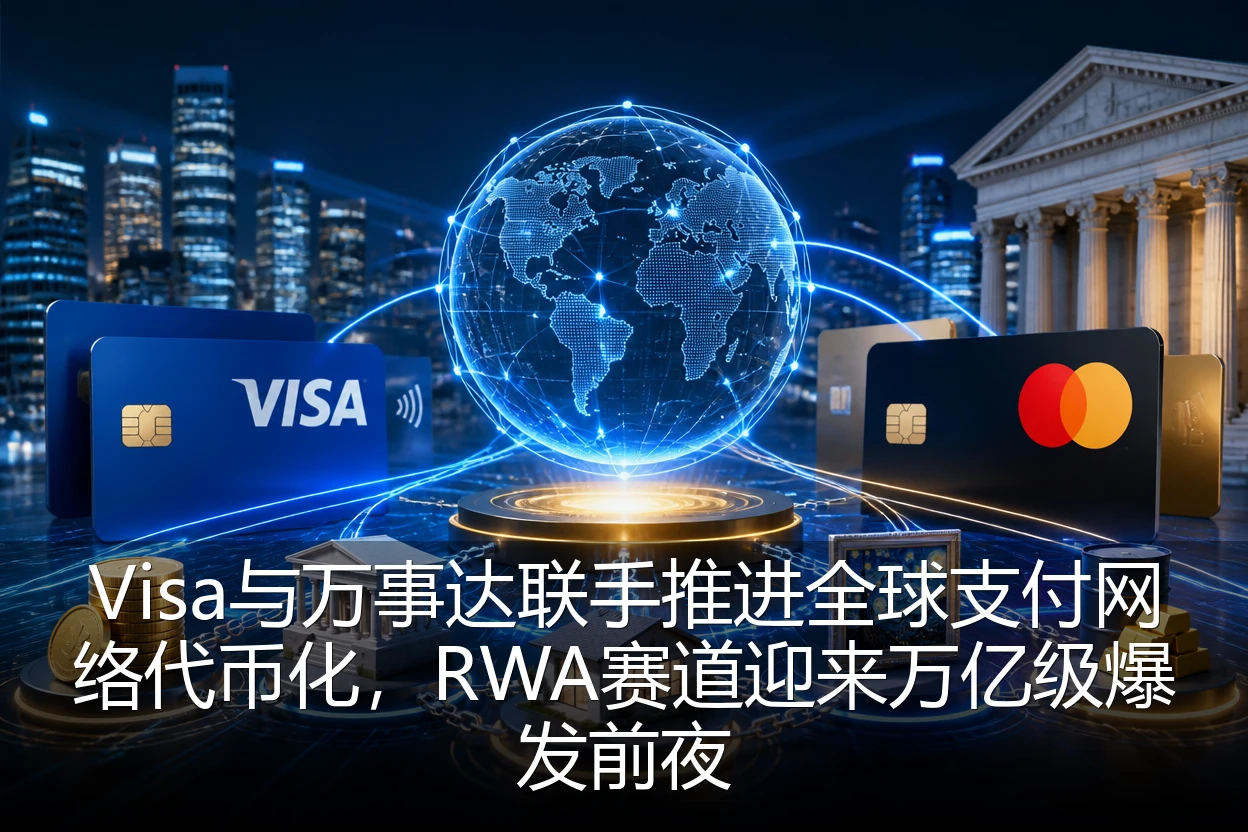
Payment Giants Make Move: Ultimate Fusion of Traditional Finance and Blockchain
August 3, 2026, marked a historic moment for global payment infrastructure. Visa and Mastercard officially announced that they have jointly developed and promoted an open "Global Payment Network Asset Tokenization Standard." This standard aims to map traditional credit card points, fiat currency collateral, and a broader range of real-world assets (RWAs) to on-chain tokens through blockchain technology, achieving instant settlement and seamless flow worldwide.
This move is seen by the industry as a landmark event where traditional financial giants have completely let go of their reservations about Web3 and fully embraced blockchain technology. Over the past decade, credit card networks have been the hub of the global digital economy, and now, these two giants have chosen blockchain as the next-generation settlement layer. This not only greatly reduces the time for cross-border payments and settlements but also brings the concept of "value on-chain" to billions of mainstream consumers.
RWA Track Explodes: Moving from Crypto-Native to Mainstream Attention
Stimulated by this major news, the RWA (Real World Assets) sector in the crypto market experienced a comprehensive surge over the weekend. As one of the core logics for "why invest in blockchain," the RWA track has always been seen as the biggest bridge connecting traditional finance and the crypto world.
According to on-chain data, as of this Monday, the total market value of global RWA asset tokenization has exceeded $85 billion, with net capital inflows exceeding $1.2 billion in the past 72 hours. Among them, private credit, US Treasury tokenization, and emerging credit card point tokenization protocols have become the three sub-sectors with the most intense capital inflows. The market value of BlackRock's US Institutional Digital Liquidity Fund on the Ethereum chain also hit a historical high, confirming that institutional funds are accelerating entry through compliant channels.
Industry analysts point out that the entry of Visa and Mastercard has completely changed the previous situation in the RWA track dominated by "crypto-native geeks." The on-chain of credit card points and fiat currency collateral means that daily consumption scenarios will be deeply integrated with decentralized finance. Users' real-world consumption behaviors will directly transform into on-chain liquidity, providing a continuous underlying asset support for decentralized lending and liquidity mining.
Deep Analysis: Why Invest in Blockchain at This Time?
At the beginning of the second half of 2026, many investors are asking: with Bitcoin breaking through $150,000 and Ethereum standing at $6,000, has the dividend period for blockchain investment ended? The move by Visa and Mastercard gives a clear answer—the "first half" of infrastructure construction is nearing its end, but the "second half" of "comprehensive asset tokenization" has just begun.
1. Dimensional Strike in Settlement Efficiency
Traditional cross-border credit card settlements often go through multiple intermediaries such as issuing banks, acquiring banks, and clearing networks, taking several days and involving high fees. After introducing blockchain as the settlement layer, assets can be transferred cross-border point-to-point in seconds, with costs almost negligible. This improvement in efficiency is not just an upgrade to the existing financial system but a reshaping of business models. Blockchain is no longer just a speculative target but has become an indispensable "next-generation market infrastructure."
2. Liquidity Release of Real-World Assets
In the past, the value consensus of blockchain investment was limited to Bitcoin's "digital gold" narrative. But with the maturity of RWA, illiquid assets such as real estate, bonds, art, and even credit card points can be split, tokenized, and traded globally through blockchain technology. This has released huge liquidity premiums for traditional assets. When investors invest in blockchain now, they are actually investing in an underlying protocol that can reshape the global asset liquidity allocation.
3. Mass Adoption of Web3 Payments
The tokenization standard of Visa and Mastercard will make future payment behaviors inherently programmable. Smart contracts can automatically execute consumption rebates, point exchanges, and installment payments, saving a lot of manual reconciliation and trust costs. When the daily payments of billions of users are deeply integrated with the blockchain underlying layer, Web3 will truly achieve mass adoption. For investors, laying out the public chain infrastructure, cross-chain bridge protocols, and DeFi liquidity pools that support the operation of this huge payment network will be the most certain investment opportunities in the next three to five years.
Market Reaction and On-Chain Data Tracking
Looking at on-chain data, Ethereum Layer 2 networks saw a surge in transaction volume over the weekend following the announcement. As core networks for RWA asset issuance and trading, Arbitrum and Optimism experienced a significant increase in daily transaction counts compared to the previous week. Meanwhile, stablecoin deposit sizes on mainstream DeFi lending protocols like Aave and Compound hit new highs for the year, indicating that funds are preparing for the upcoming large-scale tokenized asset collateral.
In addition, according to mainstream cryptocurrency market trends, Ethereum (ETH), as the preferred underlying network for RWA asset issuance, has shown strong resilience and upward momentum in its price movement. At the same time, Bitcoin (BTC), although entering a short-term high consolidation, continues to see whales adding positions as the value anchor of the entire crypto ecosystem, accumulating strength for the next wave of market movement.
Conclusion: Grasping the New Era of the Digital Economy
Visa and Mastercard jointly promoting payment network tokenization is not just a simple industry news but a clarion call for the comprehensive leap of the digital economy into the Web3 era. For investors who have been on the sidelines, this answers the fundamental question of "why invest in blockchain"—blockchain technology has crossed the proof-of-concept stage and is substantively taking over the main artery of global value flow.
In future wealth creation, whoever can first understand and layout the asset tokenization and Web3 payment ecosystem will occupy a favorable position in the financial changes of the next decade. Investors are advised to continue paying attention to the leading protocols in the RWA track, mainstream public chains with strong ecological appeal, and innovative projects that provide compliant asset custody and tokenization services, and actively embrace this historic investment opportunity with controllable risks.