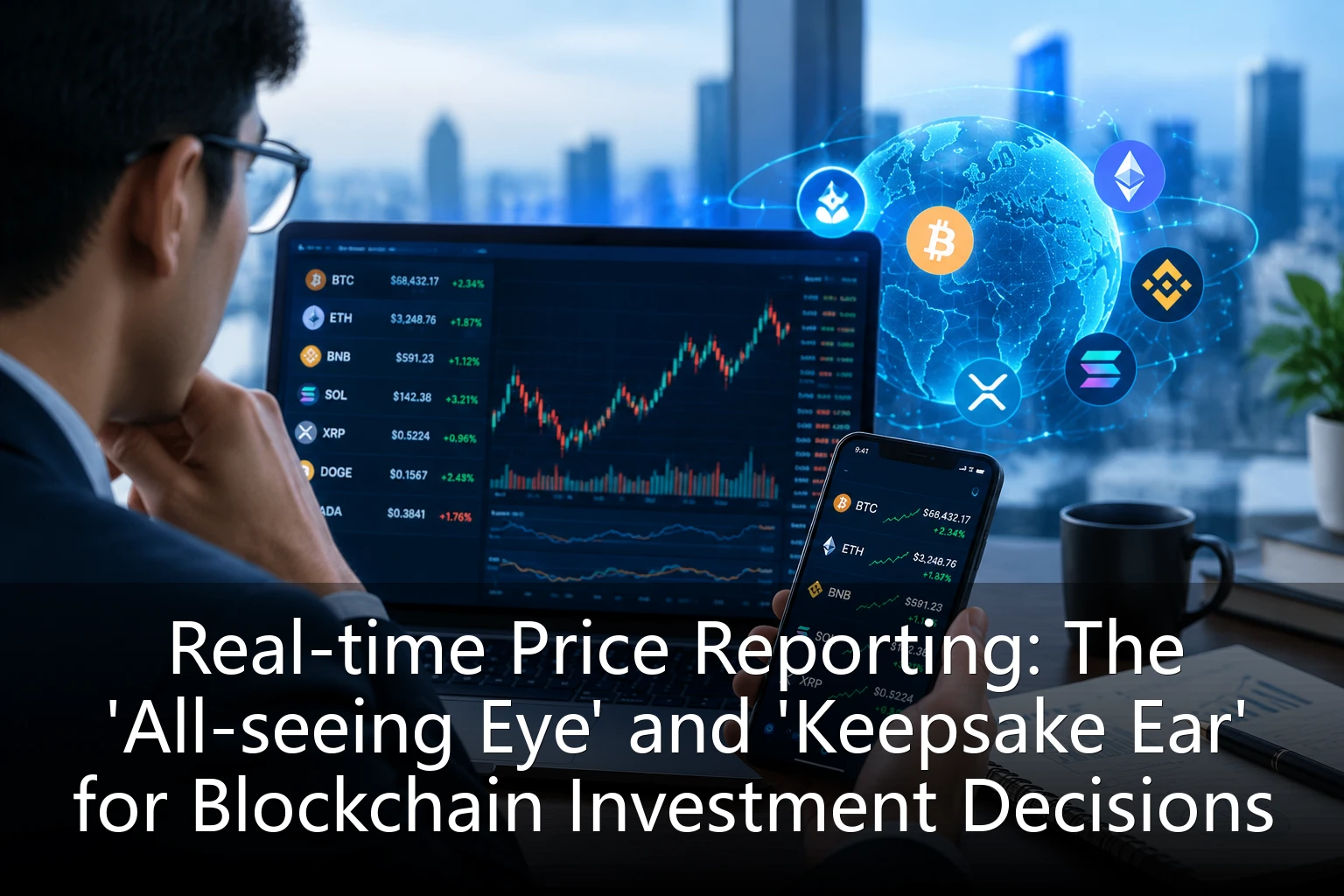
In today's rapidly evolving digital asset landscape, real-time price reporting systems have become indispensable "all-seeing eyes" and "keepsake ears" for blockchain investors. As the cryptocurrency market enters a new phase of institutionalization and professionalism in 2026, the timeliness, accuracy, and comprehensiveness of price data directly determine the quality of investment decisions and market competitiveness. This article will delve into the technical architecture, application scenarios, and investment value of real-time price reporting systems, helping investors seize opportunities in the volatile cryptocurrency market.
\n\nReal-time Price Reporting: The Nerve Center of Blockchain Investment
\n\nBy September 2026, the total market capitalization of the global cryptocurrency market has exceeded $5 trillion, growing nearly 20 times compared to 2020. Against this backdrop, real-time price reporting systems have evolved from simple market display tools into comprehensive data platforms connecting investors, exchanges, miners, and institutions. Industry data shows that professional investors monitor an average of over 50 trading pairs daily through real-time price systems, with decision response times shortened to the millisecond level—a 10-fold improvement compared to three years ago.
\n\nThe core value of real-time price reporting lies in its ability to provide an "instant panoramic view" of market dynamics. Whether it's the critical moment when Bitcoin breaks through the $175,000 mark or the surge in trading volume driven by the explosion of the Ethereum Layer2 ecosystem, real-time price systems capture these market signals at the first opportunity, providing a basis for investment decisions. Unlike traditional financial markets, cryptocurrency markets operate 7×24 hours without interruption, with more volatile price fluctuations, making real-time price reporting a lifeline for blockchain investment.
\n\nTechnical Architecture: From Data Collection to Intelligent Analysis
\n\nModern real-time price reporting systems adopt a multi-layered technical architecture to ensure data accuracy and timeliness. The data collection layer directly connects to over 200 major global exchanges through API interfaces, including Coinbase, Binance, Kraken, and others, covering over 95% of trading volume. Notably, leading price systems in 2026 have begun adopting distributed node networks, effectively reducing single-point failure risks through multi-source data cross-validation.
\n\nThe data processing layer uses stream computing technology capable of processing millions of transactions per second and achieving millisecond-level price updates. This layer also integrates anomaly detection algorithms that can identify market behaviors such as price manipulation and trading anomalies, providing investors with a more reliable data foundation. Data shows that the price accuracy of leading price systems in 2026 has reached 99.99%, an improvement of nearly 2 percentage points compared to three years ago.
\n\nThe intelligent analysis layer is where the core competitiveness of real-time price systems lies. By integrating machine learning and deep learning technologies, modern price systems can provide advanced functions such as price trend prediction, volatility analysis, and capital flow monitoring. For example, when Bitcoin price fluctuates by more than 5% in a short period, the system automatically triggers warning mechanisms and analyzes possible driving factors, helping investors react quickly.
\n\nInvestment Applications: From Passive Observation to Active Decision-Making
\n\nShort-term Trading: Capturing "Second-level Opportunities" in Price Fluctuations
\n\nFor high-frequency traders and arbitrageurs, real-time price reporting systems are key tools for capturing market opportunities. In 2026, as the cryptocurrency market becomes more professional, arbitrage profit margins continue to narrow, and the timeliness requirements for price data are increasing. Leading price systems can now provide real-time monitoring of price differences between exchanges, helping traders complete arbitrage operations in millisecond timeframes.
\n\nTake Bitcoin as an example: during market volatility, price differences between exchanges can reach 1%-3%, which for large transactions means millions of dollars in profit differences. Real-time price systems, through globally deployed monitoring nodes, can synchronously obtain price data from various exchanges and automatically calculate optimal trading paths, greatly improving arbitrage efficiency.
\n\nLong-term Investment: The "Thermometer" for Market Cycles
\n\nFor long-term investors, real-time price systems are equally valuable. By integrating on-chain data with market sentiment indicators, modern price systems can provide comprehensive assessments of market cycles. For example, when Bitcoin prices are at historical highs but on-chain activity continues to decline, this may signal overheating risks; conversely, when prices are low but on-chain transfer volumes surge, it may indicate that institutional capital is quietly entering the market.
\n\nIn the first half of 2026, after Grayscale submitted its XRP spot ETF application, real-time price systems monitored a 300% surge in XRP on-chain transfers, while exchange holdings increased. This series of signals helped early-positioned investors gain returns of over 200%. This shows that real-time price systems are not just price displays, but also "barometers" of market sentiment and capital flows.
\n\nRisk Management: Building a Dynamic Defense System
\n\nIn the high-volatility environment of the cryptocurrency market, risk management is key to investment success. Real-time price systems provide comprehensive risk warnings to investors through multi-dimensional indicator monitoring. For example, when the price volatility of a trading pair suddenly increases or trading volume abnormally expands, the system automatically reminds investors to adjust positions or set stop-loss orders.
\n\nIn the third quarter of 2026, a stablecoin project faced de-pegging risks, and the real-time price system triggered a warning when prices deviated from the pegged value by 0.5%, nearly 30 minutes before the market reacted, helping investors avoid potential losses. This forward-looking risk monitoring capability makes real-time price systems indispensable risk management tools for investors.
\n\nMarket Evolution: From Price Display to Intelligent Decision-Making
\n\nWith the continuous development of blockchain technology, real-time price systems are also constantly evolving. Leading price platforms in 2026 are no longer simple data display tools but comprehensive decision support systems integrated with artificial intelligence, big data analytics, and blockchain technologies. These systems not only provide real-time prices but also offer personalized investment recommendations based on investors' risk preferences and investment goals.
\n\nFor example, an institutional investor set up a complex trading strategy through a real-time price system: automatically increasing positions when Bitcoin prices break through $170,000 and holdings rise; partially reducing positions when prices fall below $160,000 and trading volume abnormally expands. This strategy helped the institution avoid potential losses of nearly 15% during market fluctuations in August 2026.
\n\nChallenges and Opportunities: Balancing Data Quality and Privacy Protection
\n\nDespite playing an increasingly important role in blockchain investment, real-time price systems also face numerous challenges. Data quality is the primary challenge—due to the high decentralization of the cryptocurrency market, prices may vary across different exchanges, ensuring data accuracy and consistency is a technical challenge.
\n\nPrivacy protection is another major challenge. With increasing regulatory requirements, how to protect user privacy while providing real-time data has become a problem that price system developers must face. In 2026, leading price systems have begun adopting privacy protection technologies such as zero-knowledge proofs to protect users' transaction privacy while ensuring data accuracy.
\n\nFuture Outlook: Intelligence and Personalization
\n\nLooking ahead, real-time price systems will move toward more intelligent and personalized development. With the advancement of artificial intelligence technology, future price systems will be able to provide more accurate price predictions and deeper market analysis. For example, by integrating macroeconomic data, on-chain data, and social media sentiment, systems may predict market trends in advance, providing more forward-looking decision support for investors.
\n\nPersonalized services will become another important development direction. Future price systems will be able to provide customized data display and analysis functions based on investors' risk preferences, investment goals, and trading habits. For example, conservative investors may focus more on stablecoin prices and volatility indicators, while aggressive investors may pay more attention to capital flows of high-volatility altcoins.
\n\nAdditionally, with the continuous development of DeFi and Layer2 ecosystems, real-time price systems will also face new opportunities and challenges. How to accurately track price data from decentralized exchanges and handle complex transactions on Layer2 will drive the development of real-time price systems to higher levels.
\n\nConclusion: The New Era of Data-Driven Investment
\n\nIn the field of blockchain investment, real-time price reporting systems have evolved from simple auxiliary tools to the core driving force of decision-making. As market specialization deepens, data quality and analytical capabilities will become key factors in investment success. For investors, mastering the use of real-time price systems and understanding their underlying technical logic has become an essential investment skill.
\n\nThe cryptocurrency market in 2026 has entered a new phase of institutionalization and professionalism, with increasing complexity and professionalism requirements for investment decisions. As a bridge connecting the market and investors, real-time price systems will continue to play an irreplaceable role. In the future, with continuous technological advancements, real-time price systems will become more intelligent, accurate, and personalized, providing stronger decision support for investors.
\n\nIn this new era of data-driven investment, investors who can effectively utilize real-time price systems will seize opportunities in the volatile cryptocurrency market and achieve long-term stable investment returns. For price system developers, continuously innovating technology and improving service quality will be key to winning market competition.