South Korea’s AI Megaproject Signals a New Memory-Industry Race
Keywords: South Korea, AI investment, Samsung Electronics, SK hynix, DRAM, HBM, server memory, semiconductor competition, memory supply, AI data centers
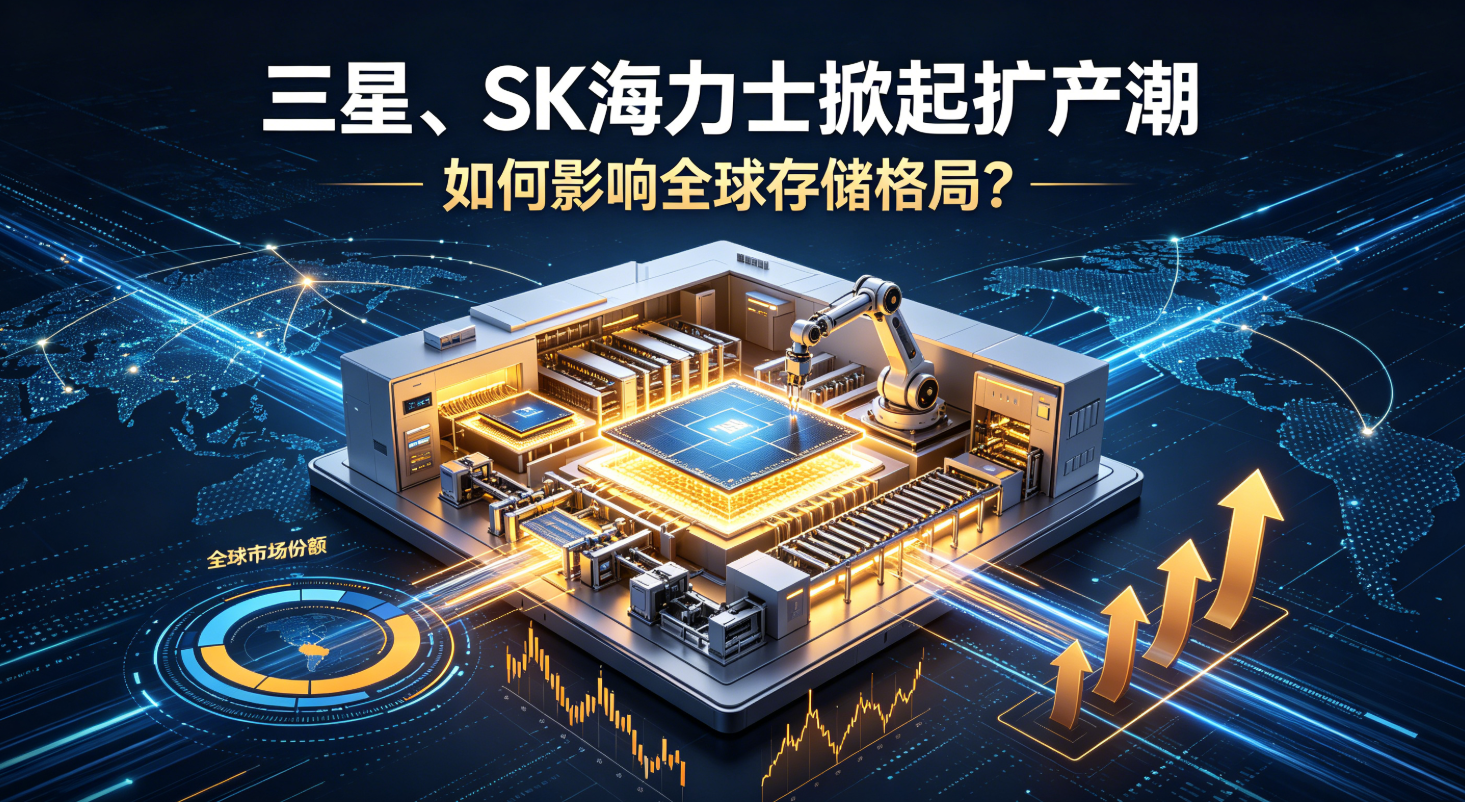
South Korea’s newly announced AI investment plan has drawn global attention not only for its scale, but also for its potential to reshape the memory semiconductor industry. On June 29, the Korean government, together with Samsung and SK Group, unveiled a massive domestic investment package centered on semiconductors, physical AI, and AI data centers. Yet despite the strategic significance of the announcement, the stock market response was unexpectedly cautious: Samsung Electronics fell 4.86% that day, while SK hynix declined 1.68%, and both stocks remained volatile in intraday trading on June 30.
This divergence between industrial ambition and capital-market reaction highlights a core question: will the investment wave reinforce Korea’s dominance in memory, or will it merely accelerate a broader global capacity race that could eventually pressure pricing and margins?
A New Round of Capacity Competition Begins
The Korean government’s plan involves a total corporate domestic investment of 4,755 trillion won, with 800 trillion won earmarked for building four semiconductor fabs in the country’s southwest region. Samsung Electronics and SK hynix are each expected to construct two of these facilities. In parallel, SK hynix plans to invest 1,100 trillion won to expand DRAM and NAND flash supply, while Samsung intends to build a new wafer fab in Gwangju and add new HBM facilities in Cheonan and Yongin, with a combined investment of 56 trillion won for the HBM-related project.
At first glance, these numbers appear to signal an all-out expansion. But the deeper significance lies in what is being expanded. The new capacity is not aimed at generic memory alone; it is primarily targeted at server DRAM and HBM, two product categories most directly tied to AI infrastructure and cloud computing. This means the investment is less about volume for its own sake and more about securing high-value demand from hyperscale data centers and AI platform operators.
The global memory market is already highly concentrated. According to Counterpoint, in the first quarter of this year Samsung Electronics, SK hynix, Micron, and ChangXin Memory held DRAM market shares of 38%, 29%, 22%, and 8%, respectively. In NAND flash, Samsung, SK hynix, Micron, Kioxia, SanDisk, and Yangtze Memory Technologies each held meaningful positions, but competition remains intense. For Korean manufacturers, the immediate challenge comes from Micron in both DRAM and NAND, while Chinese players such as ChangXin and YMTC are gradually building scale and technological depth.
AI Demand Is Strong, but Timing Still Matters
The current wave of expansion is taking place against a backdrop of tightening memory supply driven by AI demand. The problem, however, is that capacity cannot be brought online overnight. Even after the latest Korean announcements, industry expectations still point to a long lead time before significant new supply reaches the market. Most analysts now believe the next meaningful wave of memory capacity will not enter mass production until 2027 or later, with some new fabs likely to begin volume ramp-up only in the second half of 2027 or even in 2028.
This timing matters. In the memory business, supply shifts lag behind investment decisions by years, which means market conditions can change dramatically before new fabs contribute output. If demand remains as strong as expected, the additional capacity may be absorbed without major disruption. But if enterprise AI deployments slow, or if cloud customers become more conservative in ordering, the industry could face another cycle of overcapacity.
That possibility is why the market reacted with caution. Investors understand that aggressive capital expenditure can support future share gains, but it can also compress returns if it outruns demand. Memory producers have painful historical experience with such cycles, and even the most optimistic AI-driven projections are being weighed against memories of previous supply gluts.
Server DRAM and HBM: The Strategic Battleground
The most important aspect of the Korean plan is not simply more wafers, but the pursuit of leadership in server DRAM and HBM. These are the memory categories most closely linked to AI workloads and carry significantly higher margins than consumer-oriented products. They are also technically demanding, which raises the entry barrier for competitors.
For Samsung and SK hynix, the objective is clear: lock in long-term contracts with major cloud providers and secure greater share in the most profitable segments of the memory market. That strategy is already visible in the competitive landscape. In the latest quarter through May 28, Micron’s cloud memory and core data center businesses together generated more than $25 billion in revenue, accounting for well over half of its total sales. Meanwhile, ChangXin’s main downstream exposure still remains largely in consumer electronics rather than data-center applications.
HBM is even more strategic. In the first quarter, SK hynix held a 58% share of the HBM market, while Samsung and Micron each held 21%. SK hynix’s lead has narrowed compared with last year, suggesting that the race is intensifying. Samsung and SK hynix have both supplied HBM4E samples to key customers this year, while Micron expects to begin HBM4E production in 2027. All three major suppliers have already entered NVIDIA’s supply chain, underscoring how central AI accelerators have become to memory competition.
For Korean manufacturers, the immediate threat from Chinese rivals in HBM is still limited, as Chinese firms have not yet announced meaningful mass production in this segment. However, the pressure is real. Server memory demands extremely high reliability and consistency, while HBM development cycles are short, product transitions are rapid, and customer qualification standards are unforgiving. Latecomers face a steep climb.
Implications for Global Competition and Chinese Suppliers
Although the Korean expansion is aimed primarily at Western cloud and AI customers, it will inevitably influence the broader competitive landscape, including Chinese memory makers. For China’s semiconductor industry, the message is twofold. First, the high-end memory market is consolidating around a few global leaders with deep capital resources and advanced packaging capabilities. Second, the window to catch up in AI-related memory may be narrower than it appears, especially in HBM.
At the same time, the Korean expansion may also intensify the global race for equipment, materials, and engineering talent. As more suppliers announce capacity plans, industry bottlenecks could shift upstream, affecting fab construction timelines and the pace of qualification. In other words, the competitive battle is not only about chips, but about the entire ecosystem required to produce them.
Conclusion: Expansion, but Not Yet a Turning Point
South Korea’s AI investment plan marks a decisive escalation in the memory industry’s capacity race. It reflects confidence in the long-term strength of AI demand and a clear intent to defend Korea’s leadership in DRAM and HBM. But it does not yet guarantee a major shift in market balance.
The key variables remain execution, timing, and customer mix. If the new capacity comes online on schedule and secures major cloud orders, Samsung and SK hynix could strengthen their position in the most profitable parts of the market. If demand grows more slowly than expected, however, the industry may once again confront oversupply and pricing pressure.
For now, the market’s restrained reaction suggests a sober view: AI is creating a powerful memory upcycle, but the benefits will not be distributed automatically. In semiconductors, especially memory, the winner is often not the one who invests first, but the one who delivers the right capacity at the right time.